Pump Maintenance Services
Complete pump maintenance in Saudi Arabia. Preventive, routine, and emergency services for all pump types. Reliable & affordable.

CONTRACT & SERVICING
Alright, let’s talk about something that keeps Saudi Arabia flowing—literally. In a nation where sprawling cities, massive industries, and vast agricultural projects all depend on a reliable water supply, the humble pump is the unsung hero. But here’s the kicker: installing a pump is only half the battle. The real magic—and what prevents epic flood-or-drought scenarios—happens during Pump Testing and Commissioning.
This process is the grand finale, the quality check, the “let’s make sure this thing works before we all go for coffee” moment. Whether it’s a towering skyscraper in Riyadh or a new plant in Jubail, skipping proper pump installation and pump commissioning is like buying a fancy car and never checking the oil. So, grab a cup of gahwa; we’re diving into the world of pumps without the technical headaches.
Think of this article as your friendly, neighborhood guide. We’ll walk through why this process is non-negotiable in the Saudi context, break down the steps in plain English, and even show you where to find a great pump service center when you need one. By the end, you’ll see that proper commissioning isn’t just a box to tick—it’s your best insurance policy for efficiency and longevity. And if you ever think, “I need a pump service near me,” well, we’ve got you covered there, too.
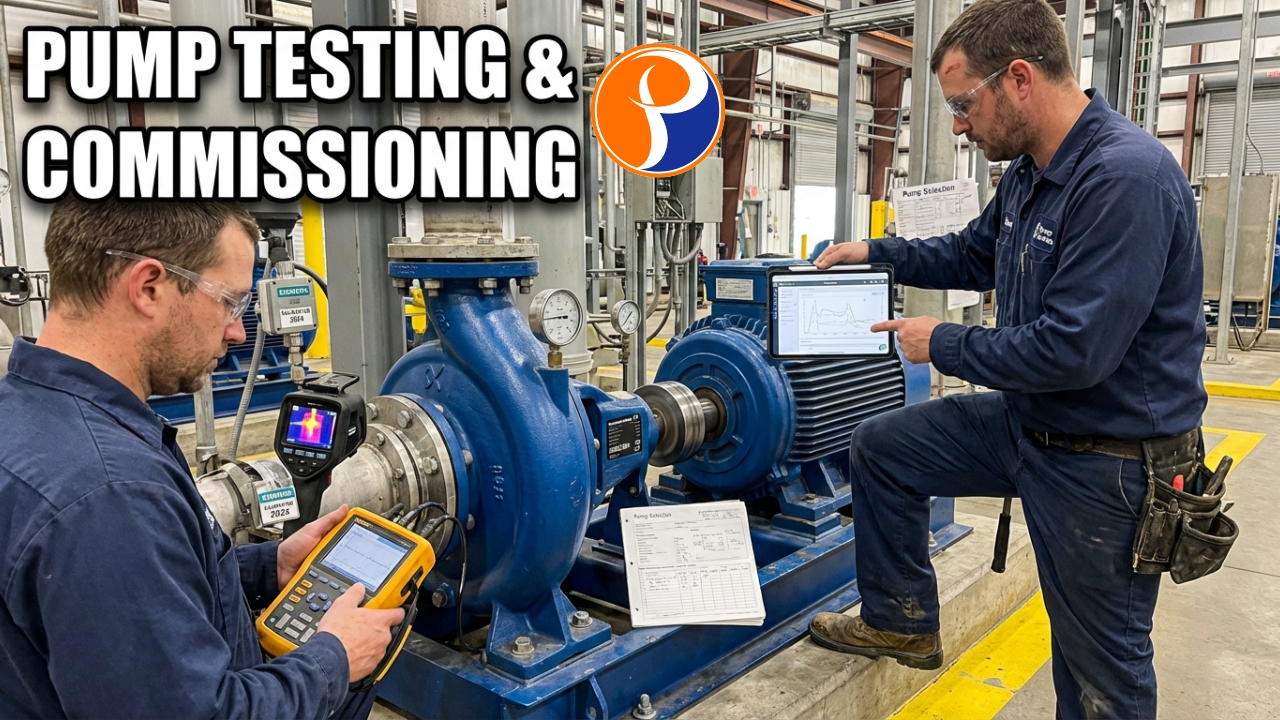
So, why all the fuss? First, consider the environment. Saudi Arabia isn’t just hot; it’s desert hot. The scorching sun and omnipresent sand aren’t exactly a pump’s best friends. Dust can clog intakes, and extreme heat can warp seals and stress motors faster than you can say “midday in Riyadh.” A rigorous Pump Testing and Commissioning procedure specifically accounts for these local gremlins. It ensures your system is built tough from day one, capable of handling 50°C heat without throwing a tantrum. Without this tailored approach, you’re basically hoping your pump survives a trial by fire—and that’s a risky hope.
Secondly, it’s all about performance and pennies. A pump that isn’t properly commissioned might run, but it will guzzle electricity like there’s no tomorrow. In a country with immense industrial and construction projects, energy efficiency is a big deal. Proper pump installation and commissioning ensure the pump is operating at its optimal point on the curve, delivering the right flow and pressure without wasting megawatts. It finds those hidden leaks, alignment issues, or voltage problems that silently drain your budget. Simply put, commissioning turns a costly energy hog into a lean, mean, water-moving machine.
You wouldn’t start a desert trek without water and a map, right? The same logic applies here. Before any testing spins a single impeller, you need your ducks in a row. This phase is all about preparation. Firstly, you need the right paperwork—the pump’s data sheets, the system design drawings, the manufacturer’s manual (yes, someone does need to read it), and the all-important Fire Pump Testing and Commissioning Procedure if it’s a life-safety system. This isn’t bureaucracy; it’s your cheat sheet. It tells you what the pump should do, so you can measure what it actually does.
Next, gather your tools and your team. We’re talking about pressure gauges, flow meters, electrical multimeters, laser alignment tools, and, crucially, experienced technicians. A visual inspection is your first line of defense. Look for shipping damage, ensure the foundation is level and cured (especially important for those heavy-duty booster pump testing and commissioning jobs), and verify all piping is supported and aligned. Forcing pipes to connect to the pump flanges is a big no-no—that’s a guaranteed leak waiting to happen. This stage might seem boring, but it’s where you prevent 80% of future headaches. A little patience during prep saves a ton of Repair & Service calls later.
Now for the action! Let’s break down the core Pump Testing and Commissioning sequence into bite-sized pieces. Remember, safety first—make sure everyone knows the plan and the emergency stops.
This is your final systems check. Confirm the rotation of the motor (a motor running backward is surprisingly unhelpful). Manually rotate the coupling to ensure nothing is stuck internally. Check that all valves are in their correct start positions—typically, the suction valve is open, and the discharge valve is partially or fully closed to reduce starting load. Lubricate the bearings as per the manual. Verify electrical connections are tight and that voltages are within spec. It’s a meticulous process, but it’s the difference between a smooth start and a loud, expensive bang.
Hold your breath, hit the start button. For a very short duration (a few seconds), you do a “bump” or “jog” test to confirm final rotation. Then, for a proper dry run (without system pressure), let it run for a brief period. Listen. Listen for any unusual sounds—grinding, screeching, or heavy vibration. Your hands on the bearing housings can feel a lot; they should be smooth, not shaky. This step is like a first impression; if something sounds off now, it won’t get better with time. If it passes the ear test, you’re ready to add water to the equation.
Here’s where we get scientific. Now you open the system up and put the pump to work. You’ll methodically measure flow, pressure, and amperage draw. For a comprehensive booster pump testing and commissioning, you’ll run tests at various points by throttling the discharge valve to simulate different system demands. You’re comparing your real-world numbers to the manufacturer’s performance curve for the pump. Is it meeting the designed head and flow? Is the power consumption within range? This data is gold. It tells you if the pump is correctly sized and if the system has any hidden restrictions.
A pump can be a sprinter, but you need a marathon runner. After performance checks, the pump should undergo a sustained run, often for 2-4 hours or more for critical systems. This prolonged operation reveals problems that a short test won’t: Do bearing temperatures stabilize at a safe level, or do they slowly creep up? Does the mechanical seal leak after an hour? Are there any vibrations that only appear once everything has thermally expanded? This endurance run is the ultimate stress test, ensuring reliability for the long haul.
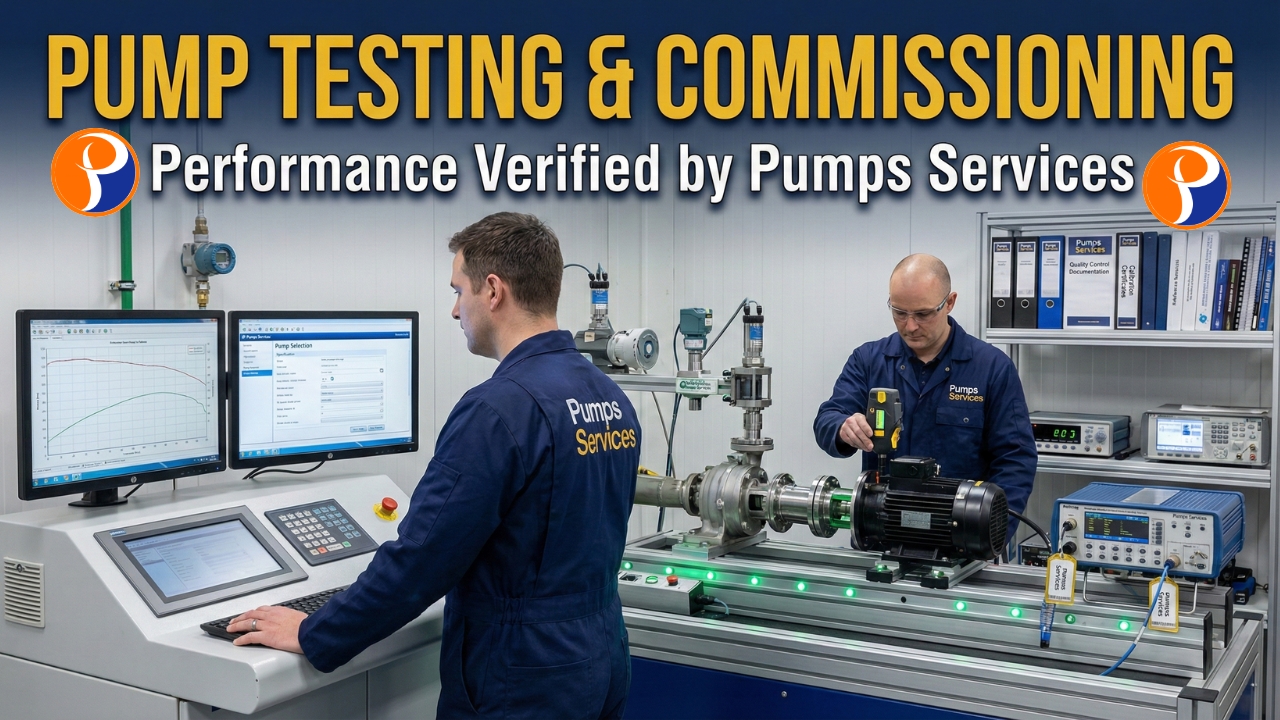
Fire pumps are the superheroes of the pump world—they sit idle 99.9% of the time, but when called upon, they must perform perfectly. The Fire Pump Testing and Commissioning Procedure is a whole different beast, governed by strict standards like NFPA 20. It’s not just about performance; it’s about reliability under crisis conditions. This involves rigorous controller tests, simulating power failure transfers to backup generators, and full-flow duration tests. Given the critical safety role, this is one area where you absolutely want certified professionals handling the job. Cutting corners here isn’t an option; it’s a major compliance and life-safety risk.
Commissioning gets your pump to the starting line in peak condition, but pump maintenance is what keeps it winning races for years. Think of it like a car—regular oil changes prevent engine seizures. In the harsh Saudi environment, maintenance is your shield. This includes regular-schedule tasks: checking and replacing lubrication, monitoring vibration levels, inspecting seals for leaks, and cleaning filters (especially important with all that airborne sand). A simple, consistent logbook of performance data can alert you to a gradual decline in efficiency before a catastrophic failure.
Moreover, don’t underestimate the power of a good partner. Establishing a relationship with a reliable pump service center means you have experts on call. Whether you need routine pump maintenance or an unexpected Repair & Service, knowing who to call is half the battle. For instance, if you’re running a project in the holy city and need a pump service near Makkah, having a trusted local provider can mean the difference between a one-day downtime and a week-long shutdown. They understand local water quality and common issues, and can provide faster response times.
Speaking of partners, this is where we toot our own horn—just a little. When your search for “pump service near me” begins, you want a team that knows the region inside and out. You need a service that doesn’t just fix pumps but understands the entire lifecycle, from flawless pump installation and pump commissioning to proactive maintenance and repair. A partner who stocks the right parts and has the diagnostic tools to get it right the first time.
For comprehensive support across Saudi Arabia—from initial commissioning to emergency repairs—consider contacting the experts at Pumps Services. They combine technical expertise with local knowledge to keep your systems running smoothly. Got a question or a looming project? Give them a call at +966564709249. Think of them as your pit crew in the high-stakes race of fluid management.
In conclusion, Pump Testing and Commissioning in Saudi Arabia is far from a mere technical ritual. It is a critical, value-driven process that ensures reliability, maximizes efficiency, and protects your significant investment against the kingdom’s challenging environment. From the meticulous Fire Pump Testing and Commissioning Procedure to the steady rhythm of ongoing pump maintenance, each step lays the foundation for performance. It turns a piece of mechanical equipment into a dependable asset.
Therefore, whether you’re overseeing a massive infrastructure project, managing a hospital’s water supply, or ensuring a hotel’s comfort, never rush or bypass the commissioning phase. Invest the time upfront to verify everything. And build a relationship with a quality service provider. Your future self—enjoying that problem-free cup of gahwa while your systems hum along perfectly—will thank you for it. After all, in the desert, water is life, and the pump is its beating heart. Keep that heart healthy.